Product successfully added to your shopping cart
Subtotal of your cart (1 item)
(tax excl.)
:
On 12 February 2026, PeopleCert officially released the new ITIL® (Version 5) — the next evolution of the world's most widely adopted service management framework. For organisations and professionals who rely on ITIL to create value through digital products and services, this is a milestone worth understanding in depth.
At B2B Learning, an Accredited Training Organisation (ATO) for ITIL since 2012, we've been closely following every stage of this release. In this article we break down what has changed, what stays the same, and — most importantly — what it means for you.
ITIL has always evolved to reflect the operating reality of the organisations it serves. The jump from version 3 to ITIL 4 in 2019 introduced the Service Value System and a more holistic, flexible approach. The new ITIL (Version 5) continues that trajectory, but with a sharper lens on three forces that now define the modern enterprise.
First, digital delivery has become continuous. Products and services no longer exist in isolation — they work together in increasingly integrated ecosystems, and management frameworks need to reflect that reality. Second, the pace of change and the complexity that accompanies it have accelerated to a point where traditional, sequential approaches to service management simply can't keep up. Third, and perhaps most significantly, AI and automation are no longer experimental add-ons — they are embedded across operations, decision-making, and customer experience.
ITIL (Version 5) responds to these shifts by expanding its scope well beyond traditional IT Service Management. It positions itself as a broader digital product and service management framework, aligned to digital transformation and AI-era operating models. The result is guidance that is more practical, more role-relevant, and more clearly tied to measurable value.
The Foundation certification has undergone a meaningful refresh. The course covers a significant amount of new content and updated practices, making it much more than a cosmetic update. If you're coming from ITIL 4 Foundation, you'll notice a stronger emphasis on digital products and services and on understanding how value is created in environments where AI is part of day-to-day operations.
One of the most welcome changes is how ITIL management practices are positioned at Foundation level. The framework still includes 34 practices (with only minor terminology refinements), but Foundation no longer expects candidates to study them one by one. Instead, the focus is on understanding what a “practice” is, how practices enable value chain activities and value streams, and how to use the consistent structure of the official practice guidance. Deeper, practice-by-practice learning is now addressed in the dedicated Practice Manager pathway and the official practice guides.
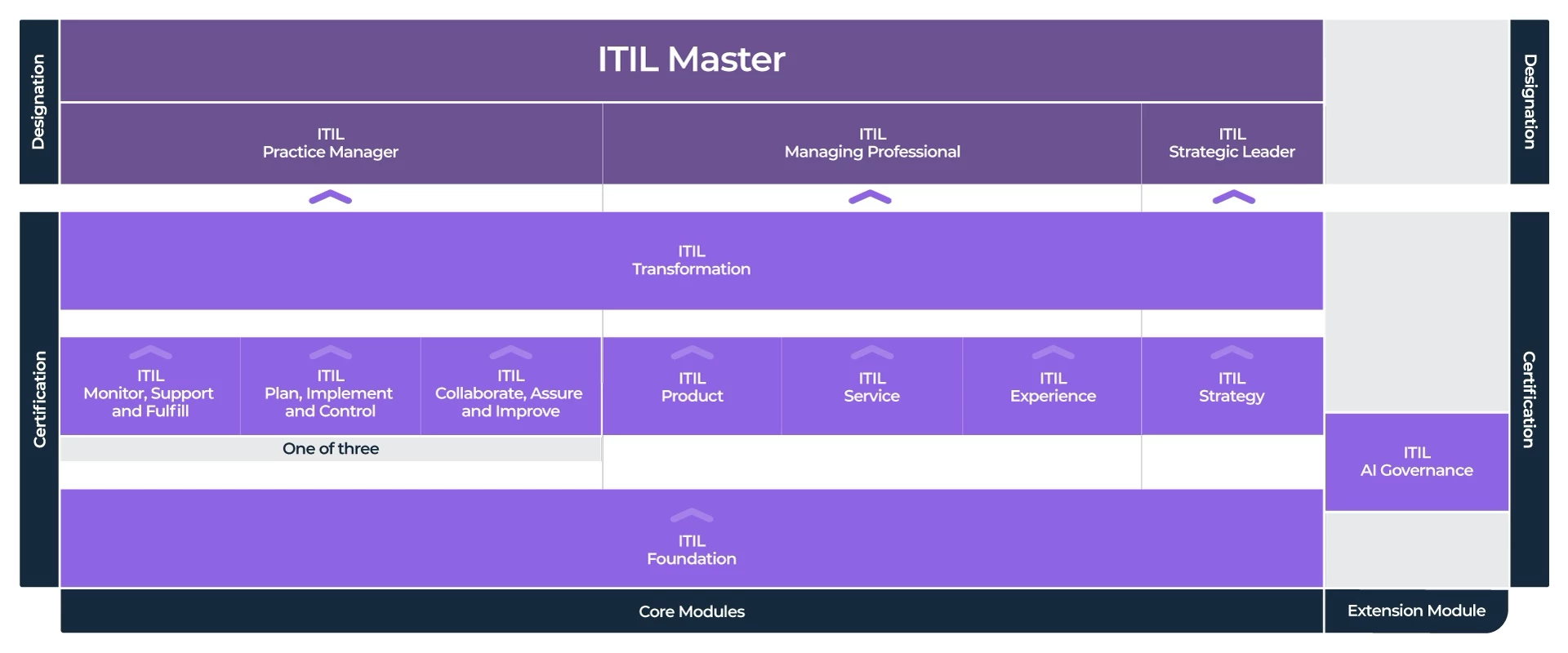
The redesigned qualification structure is more intuitive and aligned to job roles. Organisations benefit from AI-driven guidance and a practical, experience-based approach across all modules.
Every pathway begins with ITIL Foundation and progresses along a clearly defined route towards one or more of the three designations, or all three en route to ITIL Master.
Learners can then choose the pathway that best meets their needs:
To gain these designations, candidates must take the ITIL Transformation core module, which is required for all three designations. Taking this course and/or exam once brings the ability to design and manage improvements across the service value system, as well as applying these improvements across the certification path.
A new stand-alone “Extension Module on AI Governance” will be introduced. It is designed for professionals who want to develop specialised expertise in managing AI complexity responsibly. It supports confident decision-making, risk awareness and the value-driven use of AI across digital products and services. It also complements the core certifications. There is no entry-level certification required for this qualification.
ITIL (version 5) introduces a three-year renewal date for all certificates. Renewal routes are consistent with current approaches: you can renew through CPD via your membership or by taking another ITIL certification.
As an Accredited Training Organisation with over a decade of ITIL experience, our goal is to make this transition as straightforward as possible for both individuals and organisations.
This involves making changes that are simple to understand and easy to communicate to colleagues and stakeholders. It means providing clear progression pathways so that no one has to guess what comes next. It also means keeping the focus on real value: providing practical guidance and experience-driven learning to ensure genuine AI readiness, rather than just awarding new badges.
Whether you are an individual planning your next certification step or an enterprise looking to transition a team, we can help you identify the most efficient pathway based on your current certification level, role and objectives.
Contact B2B Learning — we'll recommend the right path for you.
©️ B2B Learning 2026
ITIL® is a registered trademark of PeopleCert group. Used under permission of PeopleCert. All rights reserved.
Data sheet
| Category | IT Service Management & Architecture |
BlogPost
The new ITIL® (Version 5): clearer guidance for digital products and services
Exciting News for Project Managers, Programme Managers, Business Analysts, Sponsors and all individuals involved in organizational change!
What Makes PRINCE2 Agile v2 Different 𑗅 Key Benefits for Organisations and Professionals 𑗅 PRINCE2 Agile vs. PRINCE2 and other Agile Methodologies


B2B Learning | Company N° : BE0475396208 | Legal Notice & Contact | General Conditions | Cookies | Personal data
© Copyright 2026 - E-net Business, creator of e-commerce websites for businesses, self-employed, & SMB.
Product successfully added to your shopping cart